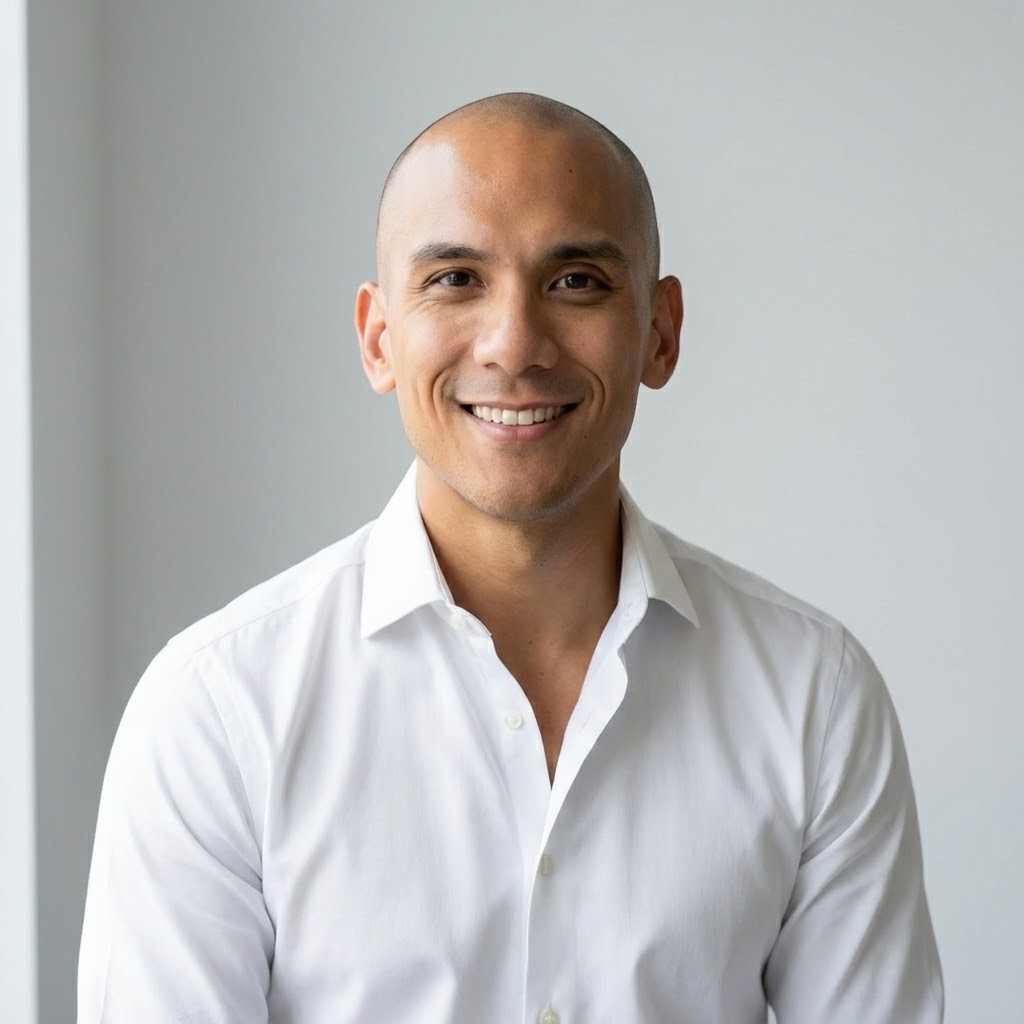
I spent 15 years trying to fix myself.
Self-help books. Motivational seminars. I bought 250 copies of Ed Mylett’s book just to spend a day at his house.1 I flew across the country for a SPECT brain scan because I thought something was physically wrong with my head.2 I did 75 Hard and made it 28 days before I started forgetting package numbers at work and losing my train of thought mid-sentence.3 I burned through $175,000 from my inherited childhood home on courses, coaches, clinics, and “opportunities” that were supposed to change everything.
None of it stuck.
Not because the advice was bad. Not because I didn’t try hard enough. I tried harder than anyone I knew. And that’s exactly what made it worse.
Here’s what my life looked like from the outside: I jumped from job to job: waiter, IT trainee, VIP concierge at a luxury mall, tree trimmer, FedEx driver, bus operator. I started a fitness business that failed. I moved eight times in five years — Saipan4 to Saint Cloud to Minneapolis to Houston — chasing something I couldn’t name. If you looked at my resume, you’d think I couldn’t commit to anything.
But here’s what it felt like on the inside: every morning felt like dragging a boulder up a hill with no top. I had discipline. I could show up, grind, outperform my coworkers. My FedEx manager said I was one of the fastest and most accurate drivers they’d ever had and that I inspired others with my mental toughness. The combination, he said, was what’s hard to find. But I dreaded every single day. The discipline was real. The purpose behind it wasn’t. And that gap — between how hard I was working and how empty it felt — that’s the part that makes you wonder if something is fundamentally wrong with you.
I thought I was broken. I thought my ADHD was the problem. I thought if I could just find the right system, the right book, the right guru, I’d finally feel like a normal person who knows what they want.
And here’s what nobody talks about: none of those people were wrong.
Each one taught me something real. Greg Plitt taught me to “never settle”.5 Vin DiCarlo’s The Attraction Code taught me that focus, intention, state, and expression all need to line up. I still use that today. Andy Frisella taught me that mental toughness isn’t optional. Every single source had genuine gold in it.
I can trace the chain exactly. Greg Plitt taught me to “give 110% of yourself”. That led me to Vin DiCarlo’s The Attraction Code, which taught me confidence was in your beliefs. That led me to Tony Robbins,6 who told me I needed to attend a $5,000 event to unlock my potential. That led me to Ed Mylett, whose book led me to buy 250 copies so I could sit in his house for a day. That led me to Andy Frisella, who said the problem was mental toughness, so I did 75 Hard until I started forgetting where I put things and what I was saying mid-conversation. That led me to Jamil Damji’s Astroflipping7 — a $30,000 real estate mastermind I spent six months trying to make work. Because by then I was convinced the answer was always in the next system, the next guru, the next investment in myself. If that chain sounds familiar, you already know how it ends. The quiet version of that thought — the one I never said out loud — was: maybe this is it. Maybe this is all I’ll ever be. Someone who chases dreams and never gets to them.
The self-help industry is worth $13.4 billion a year.8 Not because it’s all snake oil. Most of it is genuinely useful. But there’s so much of it, and each piece contains just enough real truth, that people like us become self-help junkies.9
You read the book. It shifts something. But you never stop to ask the one question that actually matters: does this make sense for me, right now, given who I actually am? 75 Hard is a legitimately great program. But when you’re doing two workouts a day on top of a nine-hour FedEx route and you start forgetting where you put your sharpie, something has to give. I didn’t quit in anger. I just thought: maybe later. The realization that dawned on me? The discipline was never the problem. The direction was.
And the whole time, a voice in the back of my mind kept asking: Will I ever build the family I want? What happens when the people I love need me and I’m still chasing the next system?
I know how this sounds. Guy burns through his inheritance and writes a blog about it. But if you’ve ever spent money you couldn’t afford on a promise you weren’t sure about — just because staying stuck felt worse — you know this isn’t about the money.
We shouldn’t have to spend our best years negotiating with that voice. I shouldn’t have had to burn through my inheritance trying to fix something that was never broken. You shouldn’t have to live with that specific flavor of dread — the kind where you’re 32 years old and your first conscious thought every morning is: “Is this really all there is?”
Here's what nobody told me: I didn't have a discipline problem. I had a misalignment problem.
Misalignment is what happens when the life you’re building has nothing to do with the person you actually are. It’s not laziness. It’s not ADHD. It’s not a lack of willpower. It’s the gap between what you’re doing every day and what actually matters to you, and your body knows it even when your mind hasn’t caught up.10
Here’s what that gap sounds like. It’s the voice that starts every morning with a list: I have to go to work. I have to do laundry. I have to budget. I have to find a job that supports long-term goals I haven’t figured out yet. I have to be disciplined about things that don’t matter to me so that one day I can find the thing that does. If you’ve ever felt that specific kind of exhaustion — not from the work itself, but from working hard at something that means nothing to you — that’s misalignment. I lived in it for years. I was disciplined with no actual purpose for the discipline, and it was the most draining thing I’ve ever experienced.
Misalignment is why your “dream job” makes you dread Mondays. It’s why the promotion left you emptier than before you got it. It’s why you keep starting things — books, businesses, morning routines, relationships — and never finishing them. Not because you can’t commit. Because your gut knows this isn’t it.
I didn’t figure this out from another book. I figured it out by accident.
In January 2025, I was SO excited when this feature came out: I connected ChatGPT to my personal journals in Notion. I wasn’t looking for a product idea. I was looking for patterns. I was looking for anything that could give me something. Something that made sense to me. Some proof that I actually stood for something. That there was a direction underneath all the noise.
I read the response. Then I read it again. Then I teared up and thought: that’s me. Not a personality type. Not a career path. A pattern I’d never seen: every meaningful thing I’d ever done — the dance crew my brothers and I started in high school, the dot technique I invented for Color Guard11 that made us win competitions, the systems I built at every job that made everything run smoother — was the same thing. I build systems that help people get aligned.
For the first time I had a clear thread connecting 15 years of “random” chapters. And from that thread, everything else fell into place: what I actually value, what I want my life to look like in 90 days, what I should be doing THIS WEEK, and what I need to do TODAY. Not because a guru told me. Because my own journals showed me.
And once I saw that, I stopped reaching for the next book. Not gradually. Like a switch. The dread stopped. The job-hopping stopped. The addictions got quieter — not because I white-knuckled them, but because they weren’t filling a void anymore. The void had a name. And the name had a direction.
I cried in my car on the way to work. I cried journaling. I cried because for the first time in 15 years, I wasn’t trying to fix myself. I was finally building something that was actually mine.
That’s what I’m building now. Not another self-help book. Not another course. A system that does what no guru, no personality test, and no motivational speech ever did for me: help you see the patterns in your own life that reveal what you actually care about, then line up your daily actions with that truth.
Maybe 75 Hard with Andy Frisella, or Tony Robbins at Date With Destiny, or Ed Mylett and his expensive home visit, or Tom Bilyeu and his truth-seeking12 is your specific jam — but how would you know if you don’t even know who you are?
I’ll share more about how it works as we go. For now, I’ll leave you with the question that finally made me stop trying to fix myself:
What if you're not broken — just misaligned?
Footnotes
-
Yes, really. Two hundred and fifty copies. Ed Mylett’s “The Power of One More” — he had a deal where if you bought enough copies, you got invited to his house for a day. His neighborhood had Adele and Justin Bieber as literal neighbors. He was tan and intense and cool. I cheered. I felt awe. But deep down all of it felt like a stage performance: beautiful, emotional, motivational… but rehearsed. It’s like I was watching a 2025 video generation AI produce an intimate scene in real time right in front of me: cool looking. No real intimacy. At least that’s what I saw with the mindset that I had at that time. I didn’t realize that until later. ↩
-
A SPECT scan is a nuclear imaging test that maps blood flow in the brain. Dr. Daniel Amen’s clinics use them to identify brain patterns linked to ADHD, anxiety, and other conditions. The clinic was beautiful: pretty Florida receptionists, smooth experience, and a Tony Robbins poster on the wall. I remember thinking: this guy is everywhere. The results showed a colorful brain with small dips — like someone had been scooping it out with a tiny spoon to taste it like frozen yogurt. They prescribed a hyperbaric oxygen chamber, $600-every-six-months Brain & Body Power Max supplements, and EMDR therapy. I stopped ordering the supplements a year ago. I’m okay. I’m still alive. ↩
-
75 Hard is a 75-day mental toughness challenge created by Andy Frisella: two 45-minute workouts a day (one outdoors), strict diet, no alcohol, a gallon of water, and 10 pages of nonfiction — every single day. Miss one task and you restart from Day 1. I made it 28 days — while working nine-hour FedEx routes. The discipline wasn’t the problem. ↩
-
Saipan is a US island territory in the western Pacific, part of the Commonwealth of the Northern Mariana Islands. About 3,300 miles west of Honolulu. ↩
-
Greg Plitt was a fitness model, actor, and former Army Ranger who appeared on over 250 magazine covers. His philosophy was pure action: stop planning, stop reading, start doing. He died in 2015 at 37. ↩
-
Tony Robbins runs several multi-day events. Unleash the Power Within (UPW) is his flagship four-day event ($1,000–$5,000+). Date With Destiny is a six-day deep dive ($5,000–$12,000). ↩
-
Astroflipping is a real estate wholesaling mentorship program created by Jamil Damji, who also hosts A&E’s Triple Digit Flip. The program has over 4,000 active members. ↩
-
U.S. self-improvement market valued at $13.4 billion in 2022, according to Marketdata Enterprises. That includes personal coaching ($2.08B), weight loss programs, self-help books, apps, and motivational events — and it’s growing 5% annually. ↩
-
Here’s the thing — self-help books actually work. A meta-analysis of 70 studies found them roughly as effective as professional therapy for things like anxiety (Marrs, 1995). But only 10–20% of what people learn in any training or course ever gets applied to their real lives (Burke & Hutchins, 2007). The insight lands. The behavior doesn’t follow — not without a system to bridge the gap. ↩
-
Psychologists call this “person–environment fit.” A meta-analysis of 172 studies found it’s one of the strongest predictors of whether you’ll thrive at work or quietly spiral toward quitting — stronger than skills, pay, or team dynamics (Kristof-Brown et al., 2005). Misalignment isn’t a metaphor. It’s measurable. ↩
-
In JROTC, a color guard is a specialized team of cadets — two rifle guards and two flag bearers — responsible for presenting the U.S. flag and school colors at ceremonies, sporting events, and competitions. Judged on precision, military bearing, and strict adherence to protocol. ↩
-
Tom Bilyeu is the co-founder of Quest Nutrition and CEO of Impact Theory, a media company with over a billion content views focused on personal development and mindset. ↩
Join the Conversation